































Kenya ACD
Mandatory document for all ports in Kenya.
The Kenya ACD — Advance Cargo Declaration is a mandatory pre-arrival cargo document for containerized shipments destined for Kenya’s ports.
The ACD reference must be obtained at the port of loading and endorsed on the Bill of Lading before the shipment proceeds to a Kenyan port.
Do not risk shipment delays, fines, cargo rejection, or Customs complications. Submit the required documents early and ensure your Kenya ACD information is complete and accurate.
What Is a Kenya ACD Certificate?
The Kenya Advance Cargo Declaration, commonly abbreviated as ACD, is a digital pre-arrival cargo declaration used to submit shipment information to Kenya Customs before cargo reaches the destination port.
It may also be associated with cargo-document terminology such as CTN, ECTN, BSC, or BESC, although the official name used for Kenya is Advance Cargo Declaration.
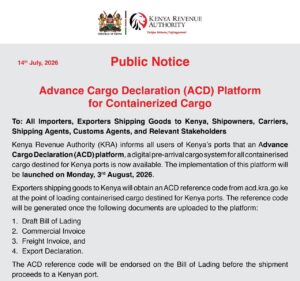
The Kenya Revenue Authority announced the launch of the ACD for containerized cargo on 3 August 2026. The public notice applies to containerized cargo destined for Kenyan ports.
Every applicable shipment must be covered by a validated declaration. All shipments unloaded at a Kenyan port must be covered regardless of their final destination.
Certificate Requirements
Which documents are required for Kenya ACD?
The following documents are mandatory for the Kenya ACD certificate.
- Bill of Lading
- Commercial Invoice
- Freight Invoice
- Export Declaration
To start the certification process, send PDF versions of the required documents to info@globalctn.com. For the issuance of ACD certifications, hard copies are not required.
Please make sure you send the final documents that don’t require revisions. After the certificates have been validated, a penalty cost will be applied for revisions.

Important Information About the Kenya ACD Certificate
The Kenya ACD forms part of Kenya’s pre-arrival cargo-control and Customs-processing procedures. It allows Customs to receive and assess cargo, vessel, exporter, importer, and transport information before the shipment arrives.
A valid declaration supports:
- Customs compliance
- Advance cargo assessment
- Shipment tracking
- Supply-chain transparency
- More efficient cargo clearance
- Earlier identification of documentation issues
Failure to obtain a valid declaration may result in fines, shipment delays, cargo rejection and, in severe cases, seizure or confiscation. Under the applicable regulations, the ACD must be obtained and validated at the port of loading, well before the vessel arrives in Kenya.
Kenya ACD Implementation Date
The Kenya Revenue Authority published its official notice on 14 July 2026.
According to the notice, the Advance Cargo Declaration platform for containerized cargo will become operational on:
Monday, 3 August 2026
Exporters, importers, shipowners, carriers, shipping agents, freight forwarders and other relevant stakeholders should prepare their procedures before the implementation date.
Who Will Issue the Kenya ACD Certificate?
The official Kenya ACD declaration and reference code are administered through the Kenya ACD system associated with the Kenya Revenue Authority — Customs and Border Control.
GlobalCTN assists exporters, freight forwarders, carriers, and other shipping parties with:
- Reviewing the required documents
- Checking shipment information
- Preparing application details
- Coordinating corrections
- Supporting the declaration process
- Following the application through to completion
Need assistance with a Kenya ACD? Contact GlobalCTN to start your application.
General FAQs
A Kenya ACD is an Advance Cargo Declaration used to submit cargo and shipment information before goods arrive at a Kenyan port.
It supports Customs compliance, advance cargo assessment, tracking, and clearance.
The systems serve a similar pre-arrival cargo-control function.
Depending on the destination country, comparable documents may be called:
- CTN
- ECTN
- BSC
- BESC
- ACD
For Kenya, the official name is Advance Cargo Declaration — ACD.
Kenyan officials describe the declaration as mandatory for shipments unloaded at Kenyan ports.
The implementation notice dated 14 July 2026 specifically confirms the ACD for containerized cargo destined for Kenyan ports from 3 August 2026.
Cargo proceeding without the required declaration may face:
- Customs delays
- Cargo holds
- Fines or penalties
- Bill of Lading amendment costs
- Carrier-documentation problems
- Delayed release at destination
- Cargo rejection
- Additional storage or demurrage
- Seizure or confiscation in serious cases
The exact consequence will depend on the shipment, the stage at which non-compliance is identified, and the decision of the relevant authorities.
A valid ACD should therefore be obtained before departure and validated within the required timeframe.
The application should be started as soon as the Draft Bill of Lading and supporting commercial documents are available.
Applicants should not wait until:
- The vessel has departed
- The Bill of Lading has been finalized
- The cargo is close to arrival
- Customs clearance has already begun
The Kenya ACD is intended to be obtained at the port of loading.
Applying early provides time to:
- Correct document inconsistencies
- Update container details
- Confirm HS Codes
- Resolve freight discrepancies
- Add the ACD reference to the Bill of Lading
- Complete validation before arrival
The ACD reference code must be endorsed on the Bill of Lading before the shipment proceeds to a Kenyan port.
The ACD is intended to be obtained at the point of loading.
Applications made after departure may lead to compliance difficulties, urgent amendments, delays, or additional costs. Applicants should begin before the vessel sails.
Shipments unloaded at a Kenyan port must be covered regardless of final destination. This indicates that cargo discharged in Kenya for onward transit may also fall within scope.
Processing time depends on:
- Document completeness
- Accuracy of the information
- Whether corrections are required
- Application volume
- Authority review
- Payment completion
- Validation requirements
A fixed processing time should not be guaranteed but if all is in place it can be approved the same day. Apply as early as possible.
The shipment may face fines, delays, rejection, cargo holds, or other enforcement measures.
Seizure or confiscation in severe cases is possible.